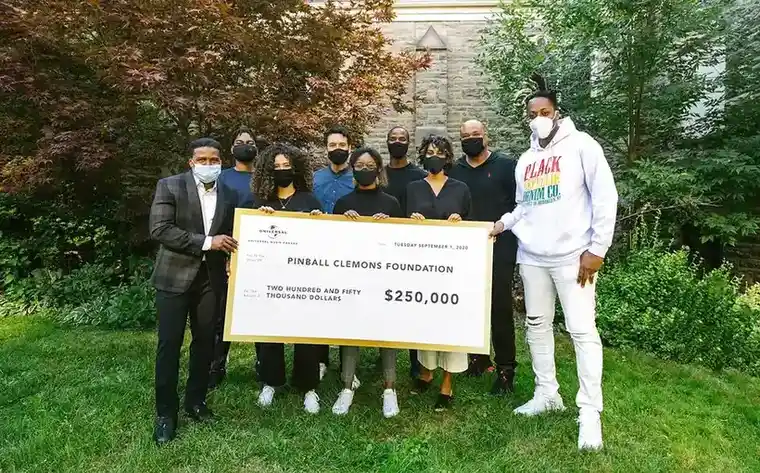
| Quick Facts | Details |
|---|---|
| Organization | Michael "Pinball" Clemons Foundation (MPCF) |
| CRA registration | Registered Canadian charity |
| Tax receipt threshold | $20 or more |
| Federal tax credit | 15% on first $200; 29% above $200 |
| Ontario provincial credit | 5.05% on first $200; 11.16% above |
| Donation types | One-time, monthly, in memoriam, bequest, corporate matching |
| Programs funded | Scholarships ($500–$5,000/year), sports mentorship, community education |
| Youth served | Ages 14–24 in Toronto and the GTA |
MPCF is a Toronto-based registered charity that funds scholarships, sports-based mentorship, and community education for youth aged 14–24 in the Greater Toronto Area. Donations go directly to program delivery — not to a granting body that redistributes funds to other organizations.
The problem MPCF addresses is specific: approximately 1 in 5 youth in Toronto's lower-income neighbourhoods does not complete post-secondary education due to financial constraints. OSAP's maximum grant for the lowest-income students is approximately $3,500 per year. A student attending the University of Toronto while renting a shared room in Scarborough faces annual costs of $25,000–$38,000. The gap between public funding and actual costs is where MPCF operates.
What Donations Fund — Scholarships, Mentorship, and Education Workshops
MPCF runs three interconnected programs. A donation supports all three, or can be directed to a specific fund.
Scholarship fund: Awards range from $500 to $5,000 per year. Some are renewable for up to four years. Recipients attend institutions across the GTA — U of T, TMU, York, Humber, Seneca, George Brown, Centennial, Sheridan. The scholarship does not replace OSAP; it fills the gap between OSAP coverage and actual costs in a city where even shared accommodation in Scarborough runs $900–$1,100 per month.
Sports mentorship: Youth aged 14–20 are matched with mentors for 6–12 months of structured engagement. Sessions cover practical topics: how to navigate a college application at TMU or Humber, how to manage part-time work alongside a full course load, how to access mental health resources through ConnexOntario or CAMH's youth services. Mentors are recruited from Toronto's amateur and professional sports communities and complete a 2-day training program before working with youth.
Community education: Workshops run across Toronto's 31 Neighbourhood Improvement Areas — Jane-Finch, Rexdale, Malvern, Flemingdon Park, Lawrence Heights, Regent Park, and others. Topics include OSAP navigation, Canada Learning Bond (CLB) basics, financial literacy, and post-secondary pathways. Many families in these communities are eligible for the CLB — a federal program that deposits $500 into an RESP with no personal contribution required — but have not claimed it. MPCF workshops address this directly.
| Program | Who it serves | What it delivers |
|---|---|---|
| Scholarship fund | Youth 16–24 applying to post-secondary | $500–$5,000/year, renewable up to 4 years |
| Sports mentorship | Youth 14–20 in GTA communities | 6–12 months of structured 1-on-1 and group sessions |
| Community education | Youth 14–24 and families | OSAP navigation, CLB, financial literacy, career workshops |
The Funding Gap That Makes Supplementary Scholarships Necessary
Toronto's cost structure creates a gap between public funding and actual post-secondary costs that OSAP alone does not close. This is the structural reason supplementary scholarships remain necessary.
A student from a household earning $45,000 per year in Jane-Finch who enrolls at Toronto Metropolitan University faces:
- Tuition: approximately $7,200–$10,500/year
- Rent (shared room, North York or Scarborough): $10,800–$13,200/year
- Food: $4,800–$6,000/year
- Transit (TTC monthly pass): approximately $1,560/year
- Books and materials: $1,000–$2,500/year
Total: $25,000–$34,000/year. OSAP's maximum package (grant plus loan) for the lowest-income students is approximately $14,000. The remaining gap — $11,000 to $20,000 — must come from family contributions, part-time work, or supplementary scholarships.
An MPCF scholarship of $1,000–$2,000 does not close this gap entirely. It reduces it enough to make the difference between continuing and withdrawing — particularly in first year, when dropout rates are highest and financial pressure is most acute.
Tax Credits for Ontario Donors — What You Actually Get Back
MPCF is a CRA-registered charity. Donations of $20 or more receive an official tax receipt. Ontario donors can claim both the federal charitable tax credit and the Ontario provincial credit.
The federal credit applies at 15% on the first $200 of annual donations and 29% on amounts above $200. Ontario's provincial credit applies at 5.05% on the first $200 and 11.16% above. These two credits stack.
Approximate tax credit values for Ontario donors (2026 rates):
| Donation | Federal credit | Ontario credit | Total credit | Net cost to donor |
|---|---|---|---|---|
| $100 | $15.00 | $5.05 | $20.05 | $79.95 |
| $250 | $44.50 | $15.68 | $60.18 | $189.82 |
| $500 | $117.00 | $43.58 | $160.58 | $339.42 |
| $1,000 | $262.00 | $99.38 | $361.38 | $638.62 |
| $2,500 | $697.00 | $266.78 | $963.78 | $1,536.22 |
| $5,000 | $1,422.00 | $545.78 | $1,967.78 | $3,032.22 |
These figures are approximations. Consult a tax professional for your specific situation. High-income donors (above approximately $246,752 in federal taxable income) may qualify for a 33% federal credit rate on amounts above $200.
A $100/month commitment — $1,200 per year — costs approximately $758 after tax credits for an Ontario donor in a mid-to-high income bracket. That amount funds a partial scholarship for one student for one year, or covers the facilitation costs of three community education workshops.
Ways to Give — One-Time, Monthly, and Planned Giving
Each giving format serves a different purpose for MPCF's operations. Understanding the difference helps donors choose the option that has the most impact.
One-time donation: Any amount. Tax receipt issued for $20 or more. Useful for donors who want to give at a specific time — end of year, in response to a fundraising event, or in memory of someone.
Monthly recurring donation: The most operationally valuable form of giving for MPCF. Predictable monthly revenue allows the organization to commit to multi-year scholarship renewals and maintain consistent program staffing. A $50/month commitment ($600/year) is more useful than a single $600 donation because it can be budgeted against program costs in advance rather than held in reserve.
Donation in memory or in honour: A gift made in someone's name. MPCF issues a tax receipt to the donor and, if requested, sends an acknowledgment to the family of the person being honoured.
Planned giving (bequest): A gift left in a will. Bequests can be structured as a fixed amount, a percentage of the estate, or a residual gift after other bequests are fulfilled. MPCF can provide information on how to structure a bequest.
Peer-to-peer fundraising: Donors who want to raise funds on behalf of MPCF can run their own campaigns — birthday fundraisers, athletic challenges, workplace campaigns — and direct proceeds to MPCF's programs.
Corporate Giving and Matching Gift Programs
Corporate donors can support MPCF through direct donations, event sponsorship, employee matching programs, or in-kind contributions. Each option has a different operational impact.
Matching gift programs are among the most effective fundraising tools available to charities. When a corporation matches employee donations dollar-for-dollar, the effective value of each employee gift doubles without additional cost to the employee. MPCF actively works with corporate partners to establish matching programs. For companies with GTA operations looking to demonstrate local community investment, alignment with MPCF's youth education and sports mentorship work is direct — particularly given the Argonauts connection and the foundation's presence in Toronto's professional sports ecosystem.
| Corporate giving option | What it involves | Recognition |
|---|---|---|
| Event sponsorship | Corporate table ($2,500–$10,000) at annual gala | Branding at event, in communications |
| Employee matching | Match employee donations 1:1 or 2:1 | Co-branded campaign materials |
| In-kind donation | Goods, services, or professional expertise | Acknowledgment in MPCF materials |
| Pro bono professional services | Legal, accounting, HR, or marketing work | Acknowledgment; direct program impact |
Pro bono professional contributions have measurable value. A lawyer who reviews contracts pro bono or an accountant who assists with CRA compliance frees up program budget that would otherwise go to professional fees. For a small non-profit, this can be equivalent to a cash donation of several thousand dollars per year.
How MPCF Compares to Other Ways of Supporting Toronto Youth
Toronto has a substantial charitable sector. Donors who want to support youth in the city have several options. The key structural difference between MPCF and granting organizations is directness.
| Organization type | How funds reach youth | Sports mentorship | Direct scholarship delivery |
|---|---|---|---|
| MPCF | Direct program delivery | Core program | Yes, directly |
| Pathways to Education | Direct program delivery | Not core | Bursary and tutoring |
| United Way Greater Toronto | Grants to other charities | Varies by grantee | Through grantees |
| Toronto Foundation | Grants to other charities | Varies by grantee | Through grantees |
| Canada Helps | Donation platform | N/A | N/A |
When you donate to MPCF, the funds go to MPCF's scholarship fund, mentorship program, or community education activities. There is no intermediate granting body. United Way Greater Toronto and Toronto Foundation are valuable parts of the ecosystem, but they operate at a different level of abstraction from direct service delivery — a donation to either organization may or may not reach a youth scholarship program, depending on that year's granting priorities.
Pathways to Education is the closest comparable organization in terms of direct delivery. MPCF's distinguishing feature is the sports mentorship model and the specific credibility that comes from Michael Clemons' personal story and the Argonauts connection — a credibility that is particularly effective with youth in communities where distrust of mainstream institutions is a real barrier to participation.
Volunteer Contributions — What MPCF Needs Beyond Donations
Financial contributions are not the only way to support MPCF's work. The organization uses volunteers in program delivery, event coordination, and administrative support.
| Volunteer role | Time commitment | What is needed |
|---|---|---|
| Sports mentor | 6–12 months, 2–4 hrs/week | Athletic background, community connection, background check |
| Workshop facilitator | 4–8 hours/month | Communication skills, subject knowledge |
| Event volunteer | 1–2 days/year | Reliability, logistics |
| Pro bono professional | Project-based | Accounting, legal, HR, or marketing expertise |
| Administrative support | Flexible | Office skills, data management |
Mentors do not need to have competed at a high level. A recreational basketball player who grew up in Malvern or Rexdale and has navigated post-secondary education is a strong candidate. MPCF's 2-day orientation covers youth development principles and trauma-informed communication. Prior experience working with youth is helpful but not required.
A former community sports participant who completes MPCF's mentor training gains a credential recognized by Toronto-area schools and community organizations — which has direct value for those pursuing careers in education, coaching, or community services.
Questions
FAQ
01How do I know my donation reaches youth programs and not administrative overhead?
MPCF is a CRA-registered charity and files annual T3010 returns with the Canada Revenue Agency. These returns include financial breakdowns — program expenditures, administrative costs, and fundraising costs — and are publicly searchable through the CRA charity database by charity name or registration number. Donors can review these filings before giving. MPCF's small staff structure reflects a deliberate prioritization of program delivery over administrative overhead. Canada Helps also publishes financial summaries for registered charities that use its platform.
02Can I direct my donation to a specific program — scholarships, mentorship, or education?
Yes. Donors can specify whether they want their contribution directed to the scholarship fund, the sports mentorship program, or community education workshops. Unrestricted donations give MPCF flexibility to allocate funds where they are most needed at a given time. Restricted donations are useful when a donor has a specific connection to one program area — for example, a donor whose family member received a scholarship, or a corporate partner whose employees are involved in the mentorship program.
03What is the minimum donation amount, and is there a maximum?
There is no minimum donation. Tax receipts are issued for donations of $20 or more. There is no maximum. Large donations — $10,000 or more — may be eligible for named scholarship funds or other recognition arrangements; contact MPCF directly to discuss options. Bequests and planned gifts are handled separately from annual giving and can be structured in multiple ways depending on the donor's estate planning situation.
04Does MPCF accept donations from outside Canada?
MPCF is a Canadian registered charity. Donations from Canadian residents are eligible for the federal and Ontario provincial charitable tax credits. Donations from non-Canadian residents do not qualify for Canadian tax credits but are accepted. Non-Canadian donors should consult a tax professional in their own jurisdiction regarding any applicable deductions. Corporate donors with Canadian operations can claim the charitable donation deduction against Canadian taxable income regardless of where the parent company is headquartered.